
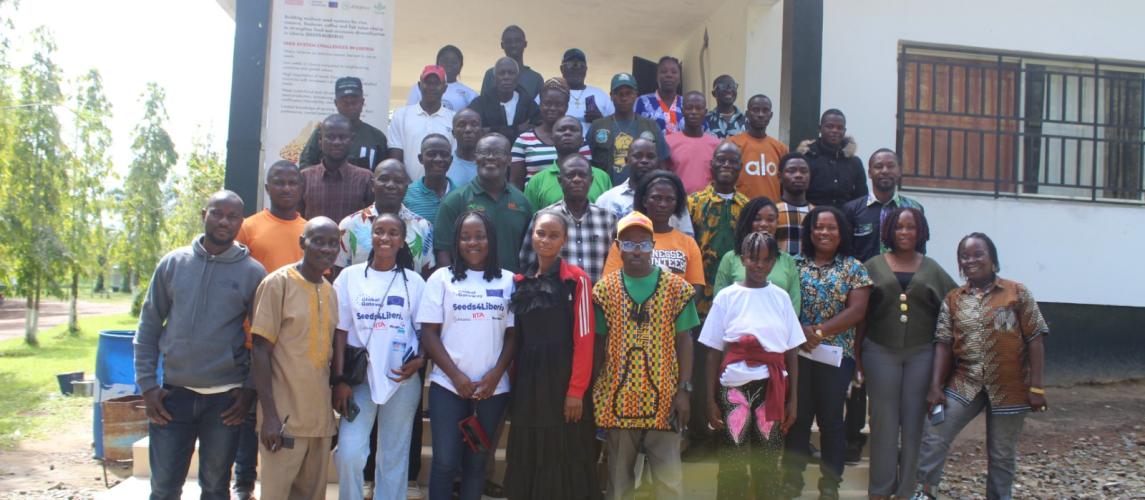
CARI Seeds4Liberia Project Reinforces Good Agronomic Practices, Climate-Smart and Agroforestry Systems for Sustainable Coffee Production in Liberia
SUAKOKO, Liberia – The Central Agricultural Research Institute (CARI), in partnership with the International Institute for Tropical Agriculture (IITA), has conducted a refresher training-of-trainers (ToT) workshop on good agronomic practices, climate-smart coffee, and agroforestry systems. The initiative forms part of the EU-funded Seeds4Liberia Project, which is building resilient seed systems for rice, cassava, coffee, soybean, and fish value chains to strengthen food security and economic diversification in Liberia.
Opening the session, Dr. Arthur Bob Karnuah, Director General of CARI, highlighted the institute’s commitment to sustainable coffee production. He noted that over 40,000 Liberica coffee seedlings are currently in nurseries for farmers, with significant resources invested in procuring polythene bags to support seedling growth. Dr. Karnuah urged participants to pay close attention to the presentations, engage actively in discussions, and ask questions to maximize knowledge transfer.
Representing the Bong County Agriculture Coordinator, Mr. George Beyan reminded participants of the training’s purpose: to strengthen coffee production practices and empower extension officers to share knowledge with farmers in their communities.
On the business dimension of coffee, Mrs. Hawa Varney, facilitator from the International Trade Centre (ITC), described coffee as “the new gold,” emphasizing its economic potential. She underscored the uniqueness of Liberica coffee and its importance as a commodity that can drive national growth. Varney highlighted diverse value-added products derived from coffee, including oil, soap, biscuits, and tea, demonstrating its potential beyond traditional exports.
Dr. Richard Asare, IITA’s representative for the coffee value chain, reinforced the importance of integrating climate-smart practices and agroforestry systems to ensure sustainability. He emphasized that the Seeds4Liberia Project is not only about seed distribution but also about building knowledge systems and strengthening farmer capacity.
Coffee Liberica is renowned for its distinctive flavor profile, offering bold, woody, and earthy notes complemented by floral, chocolaty, and fruity undertones, qualities that position it strongly in the specialty coffee market. To harness this potential, the Seeds4Liberia Project has embarked on a comprehensive coffee improvement program.
Key milestones include 706 coffee germplasm samples (leaves, beans, stems) collected in December 2024, followed by 759 samples in February 2025, the establishment of a gene bank for Liberica and mixed genotypes, and the central seedling nurseries set up across coffee-producing counties.
Additionally, the training-of-trainers model is designed to ensure effective knowledge transfer to farmers and to conduct baseline studies, assessing socioeconomic characteristics of coffee farming, profiling cooperatives, and engaging stakeholders across the value chain.
Seedling distribution has been extensive, with 267,000 coffee seedlings delivered to extension officers in Bong, Lofa, Nimba, and Montserrado counties (Liberica: 6,200; Robusta: 258,500; Arabica: 2,300). An additional 32,104 seedlings were distributed to Bong, Lofa, and Bomi counties (Liberica: 13,928; Robusta: 17,429; Arabica: 747).
The Seeds4Liberia Project, supported by the Global Gateway and the European Union, is laying the foundation for a sustainable coffee sector in Liberia. By combining good agronomic practices, climate-smart approaches, and agroforestry systems, the initiative aims to boost productivity, enhance farmer livelihoods, and position Liberian coffee as a competitive export commodity.
